
Why Clay Chimineas Crack and How to Prevent It, From the First Fire to Winter
A clay garden chiminea almost always cracks for the same reason: the clay is hit by a change that is too sudden. A lot of heat all at once, before the bowl has been cured. Cold water on a hot wall. Water that has soaked into the material and freezes in winter. A knock while it’s being moved. Fine surface hairlines are normal on ceramics used with an open fire. Cracks that go through the wall can be prevented: a few small fires at the start, sand in the bottom, moderate fires, no water on a hot bowl and dry shelter in winter.
Our clay garden chiminea care guide covers what to do after each evening and where to keep it in winter. Here we look at the other half: what actually happens in the clay when a crack appears, and how to tell what kind it is.
What happens in the clay when a crack appears
Fired clay expands when it heats up and contracts as it cools. The problem isn’t the heat itself: our chiminea is made to withstand 500-600 °C. The problem is the difference. When one part of the wall is much hotter than another, the two parts want to move differently, and the material gives way along its weakest line. That is thermal shock.
The second cause is water. Fired clay is slightly porous and absorbs a little moisture. The water in the pores can turn into steam if a wet bowl is heated quickly, and in winter it freezes and expands. Both push the material apart from the inside.
The third cause is mechanical: a knock, a fall or a weight put where it shouldn’t be. Fired clay is hard, but it isn’t flexible.
The seven usual causes
- A big fire before curing. A new bowl gets its first few fires small, with complete cooling in between. A big fire on the first evening heats the wall unevenly. The steps are in the first firing of a clay chiminea.
- Too much wood at once. Even after curing, a fire packed up to the mouth makes flames that touch the walls directly. The right fire is a moderate one, on the layer of sand, with logs added one at a time.
- Water on hot clay. A bucket or a hose over a hot bowl suddenly cools just one part of the wall. Let the fire go out on its own.
- A fire lit in a wet bowl. After rain, or after it has stood without its lid, the clay and the sand have water in them. Leave the bowl to dry for a few days, then start again with a small fire.
- Frost with moisture in the material. In winter, a chiminea left outside wet goes through freeze-thaw cycles that can flake pieces off the surface or open up cracks. That’s why it spends the winter under cover; the details are in a garden fire in winter.
- No sand in the bottom. The layer of sand, about 10 cm deep, keeps the embers away from the base of the bowl. Without it, the bottom takes the greatest heat directly.
- Knocks and lifting by the chimney. The chimney is the thinnest part. Only move the chiminea when it’s cold, lifting it by the body, from the base, and the stand must be level so the bowl doesn’t tilt.
Hairline or crack: how to tell them apart
A fine surface hairline is a thin line, usually in the outer layer or in the paintwork. It doesn’t widen from one evening to the next and you can’t see the firelight through it. Hairlines like this can appear over time on a natural ceramic chiminea used with an open fire; they are normal and don’t affect its safety or how it works.
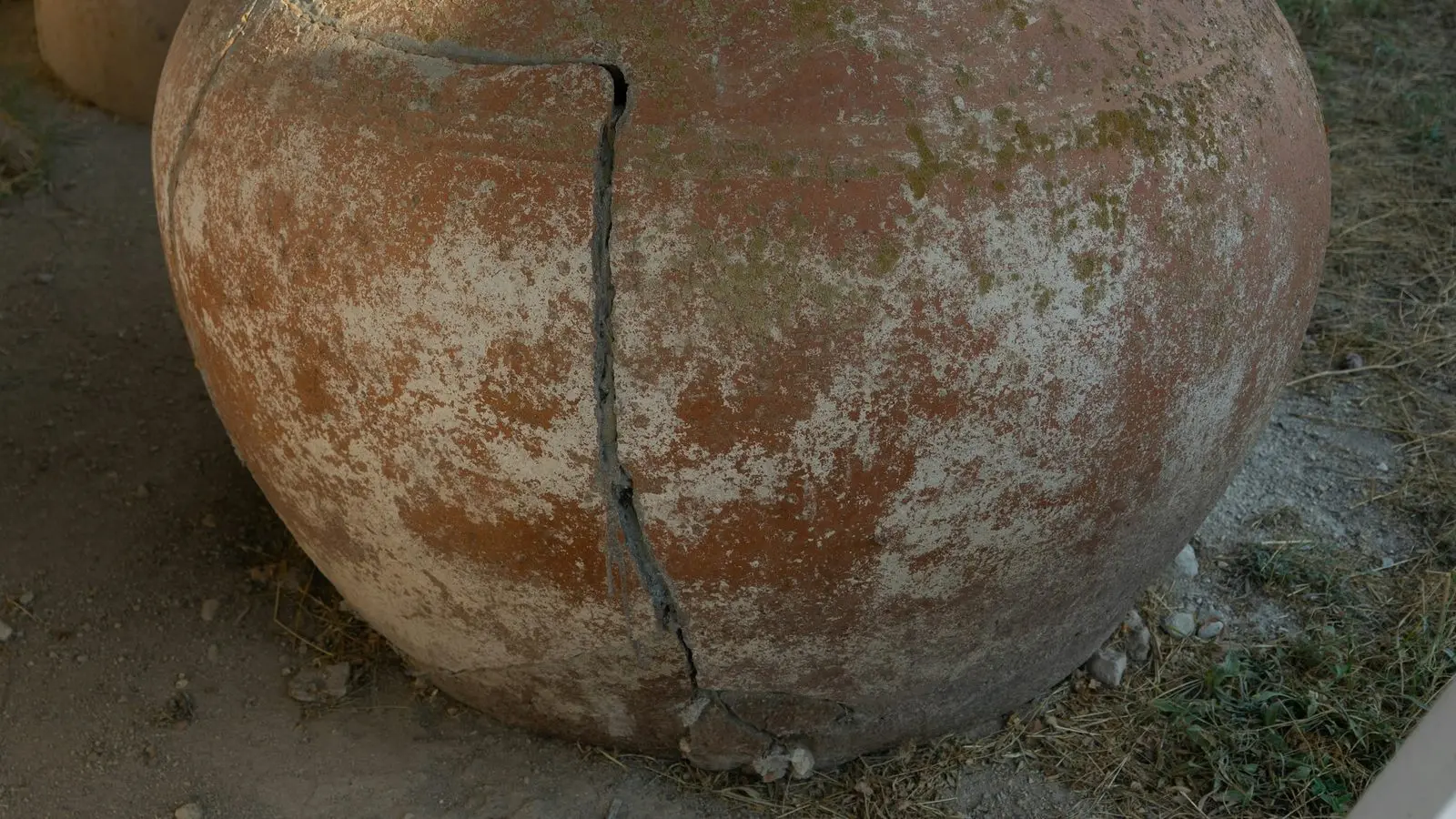
A crack that goes through the wall can be seen from the inside too, widens, lengthens or lets the firelight through. In that case, don’t light a fire in it until you know what you’re dealing with. A wall that has cracked right through can give way under heat.
A simple test, with the bowl cold: in the evening, look at the wall with a lit torch inside. If the light shows through the line, the crack goes through the wall.
How to prevent cracks, in brief
- Cure a new bowl with 3-4 small, progressively larger fires, with complete cooling in between.
- Put sand in the bottom, about 10 cm, and keep it dry.
- Burn dry hardwood, in moderate amounts. See what to burn in your garden chiminea.
- Put the lid on every time the chiminea is cold and not in use.
- Don’t pour water over it, and don’t light it when it’s wet or frozen.
- In winter, keep it under cover, dry.
- The first fire of each season is a small one, too.
How hot the bowl gets, and why the temperature difference matters more than the maximum temperature, is covered in how hot does a clay garden chiminea get.
What to do if you’ve found a crack
- Let the chiminea cool completely and look at it in good light, inside and out.
- Work out the type: fine and stable, or through the wall.
- If it’s fine, carry on as normal, with moderate fires, and keep an eye on it from time to time.
- If it goes through the wall, stop lighting fires in it. If the chiminea is one of ours and still under warranty, write to us with a photo.
The warranty, in brief
Our chimineas carry a 6-month commercial warranty for manufacturing defects, on top of the 2-year legal guarantee of conformity. The commercial warranty does not cover cracks caused by incorrect use, for example lighting a sudden, big fire without curing, nor damage from handling after delivery, nor wear from exposure to the weather without protection. Fine surface hairlines are not considered a defect. If the product arrives broken, send us a photo within 48 hours of receiving it and we’ll replace it at our expense. All the details are in our returns and warranty policy.
Our chiminea, in brief
Sparkle Stone chimineas are handmade from 100% natural, kiln-fired clay, withstand 500-600 °C, stand 87 cm tall on the tripod stand and come with a protective lid. See our clay garden chimineas. The current price is on the product page.
Is it normal for fine cracks to appear on a clay chiminea?
Yes. Fine surface hairlines can appear over time on natural ceramics used with an open fire. They don’t affect safety or how it works, and they don’t widen from one evening to the next.
Can I use the chiminea if it has a crack?
If the crack is fine and stable, yes, with moderate fires. If it goes through the wall, widens or lets the firelight show through, stop lighting fires in it.
Are cracks covered by the warranty?
Manufacturing defects are, for 6 months. Cracks from incorrect use, such as a big fire without curing, and fine surface hairlines are not covered.
How do I prevent cracks at the first fire?
With 3-4 small fires, each a little bigger than the one before, letting the bowl cool completely in between, following the steps in the first-firing guide, and with the layer of sand in the bottom.