How hot does a clay garden fireplace get? Temperature, explained simply
Our clay chimineas are made of fired clay that withstands 500-600 °C. That figure is the limit of the material, not the temperature you would measure in your fire. In practice, three things matter: the outside of the bowl gets hot enough to burn skin, the clay holds its heat for hours after the flames have gone, and the fire has to stay moderate, with the flames inside the bowl, so that the chiminea stays whole for years.
When someone searches for “chiminea temperature”, they usually want to know one of the things below: how much heat the bowl can take, how hot it is to the touch, how much it warms the area around it or how long you have to wait for it to cool. We take them one at a time and say openly what we don’t measure.
What 500-600 °C means
It is the temperature range the fired clay of our chimineas is designed for. The hand-shaped clay dries slowly, is then fired in a kiln and becomes ceramic; the firing gives it the resistance to the heat of an ordinary wood fire, built on the layer of sand in the bottom.
What clay cannot take is sudden change: a big fire in a cold bowl, water on the hot wall, frost with moisture in the material. Almost all serious cracks come from there, not from an ordinary evening by the fire.
How hot is the fire inside?
We don’t publish a measured temperature for the inside of the bowl or the outer wall, because it depends on the wood, the amount, the wind and how long the fire has been burning. A fire of dry hardwood burns hotter and cleaner than one of wet wood, which smoulders and smokes. Anyone who gives a single exact figure for “a garden fireplace” is guessing.
What we can say for certain: the fire is built on sand, in the lower bowl, and the clay around it takes up the heat and gives it back slowly. That is why a clay chiminea warms steadily, not in bursts.
How hot does the outside get?
Hot enough to burn. The clay wall takes up the heat of the fire and radiates it, which is exactly why it is so pleasant to sit beside. It is also why the bowl, the chimney and the metal stand must not be touched while the fire is burning and while it cools:
- don’t lean on it and don’t put glasses on the rim;
- don’t hang gloves, towels or blankets on it;
- children and pets stay behind a clear boundary;
- don’t move it while it is warm, but the next day, once it has cooled completely.
After the fire: how long the bowl stays warm
Long after the flames have finished. Clay holds heat, and embers under the ash can stay hot for hours. The house rule: the chiminea is left to cool on its own, until the next day. Only then do you put the lid on the chimney and clear out the ash, into a metal container. For putting the fire out and dealing with the ash, see ash from a garden fireplace.
How big should the fire be?
Moderate. The simplest guide is the flame: it stays in the bowl. If the flames come out of the mouth or the chimney, the fire is too big, both for the clay and for whatever is around it. Add logs one or two at a time, as they burn, not a full load all at once.
A new chiminea needs curing before its first real fire: a small paper fire in the empty bowl, then sand in the bottom and another 2-3 small fires, each a little bigger, with a full cool-down in between. The steps are in our first-firing guide. And at the start of every season, especially after winter, the first fire is kept small.
How much does it warm the area around it?
Enough to keep the people sitting in front of it warm. The heat comes out mainly through the mouth, and the hot clay keeps radiating even after the flames die down. It doesn’t heat a whole garden, and it isn’t made to. It works best with the chairs in a semicircle facing the mouth, and the chiminea with its back to the wind.
Clay or cast iron: which gets hotter?
They behave differently. Clay heats up more slowly than cast iron, but gives off its heat more evenly and holds it for longer. Cast iron gets hot quickly on the surface and cools just as quickly. With both, the outside must not be touched during the fire. The full comparison is in clay or cast iron garden fireplace.
Our chiminea in brief
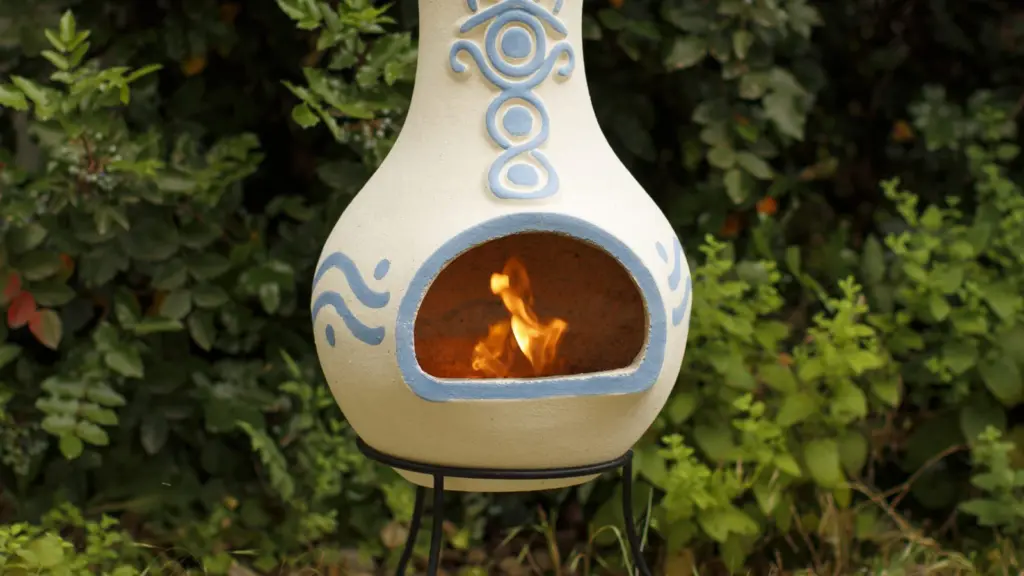
Sparkle Stone chimineas are handmade from 100% natural, kiln-fired clay and withstand 500-600 °C. They stand 87 cm tall with the three-legged stand, weigh between 17.2 and 19.9 kg and come with a protective lid. See our clay garden fireplaces or go straight to the model with red ornaments. Prices start from 570 lei (RON), VAT included, and delivery within Romania is free.
What temperature can a clay garden fireplace withstand?
The fired clay of our chimineas is designed for 500-600 °C. That is the limit of the material; the fire is kept moderate, with the flames inside the bowl.
How long does it stay warm after the fire?
For hours. Clay holds heat, and the embers under the ash stay hot long after the flames. Let it cool on its own, until the next day.
Can it get too hot?
Yes. A fire with flames coming out of the mouth or the chimney is too big. Big fires and sudden changes in temperature are what crack clay.
Does a cast iron fireplace give more heat?
Cast iron heats up faster, but it also cools down faster. Clay warms more slowly and gives off its heat more evenly, for longer.