
How to care for a clay garden chiminea: winter, cracks and the lid
A clay garden chiminea will last for years if you follow three rules: heat it gradually, starting from the very first fire, keep it dry and protect it from frost. Almost all serious cracks come from thermal shock or from water freezing inside the material, not from normal use.
Fired clay expands in the heat, contracts in the cold and absorbs a little moisture. Give it time to go through these changes and your clay fireplace becomes a piece you use season after season. Below you’ll find what to do before the first fire, after every evening, in winter and when you notice a crack.
What should you do before the first fire?
Before its first proper evening, the chiminea needs curing: first a small paper fire in the empty bowl, then a layer of sand about 10 cm deep in the bottom and a few more small fires, each a little bigger than the last, with a full cool-down in between. The detailed steps are in our guide to the first firing of a clay chiminea. Here we’ll keep only the core idea, because it still applies after curing: clay can’t stand sudden changes. The first fire of every season, especially after a winter break, deserves the same treatment, with a small flame to begin with.
How do you care for the chiminea after each use?
After every evening, let the fire go out on its own and the chiminea cool down naturally, until the next day. Water poured over hot clay is the fastest route to a crack, because it suddenly cools just one part of the wall.
- The ash comes out only when it is completely cold, with a small shovel, without scratching the inside.
- The sand layer stays in place; if it is heavily mixed with ash or has got wet, sieve it or replace it with dry sand.
- The outside is wiped with a dry or slightly damp cloth, without harsh detergents and without wire brushes, which can damage the hand-painted ornaments.
- The metal stand should be checked now and then: the legs must stand straight, on a level surface, so the bowl doesn’t tilt.
Don’t move the chiminea while it is warm. When you move it cold, lift it by the body, from the base, never by the chimney: the neck is the thinnest part of the vessel.
What is the lid for, and when do you need a cover?
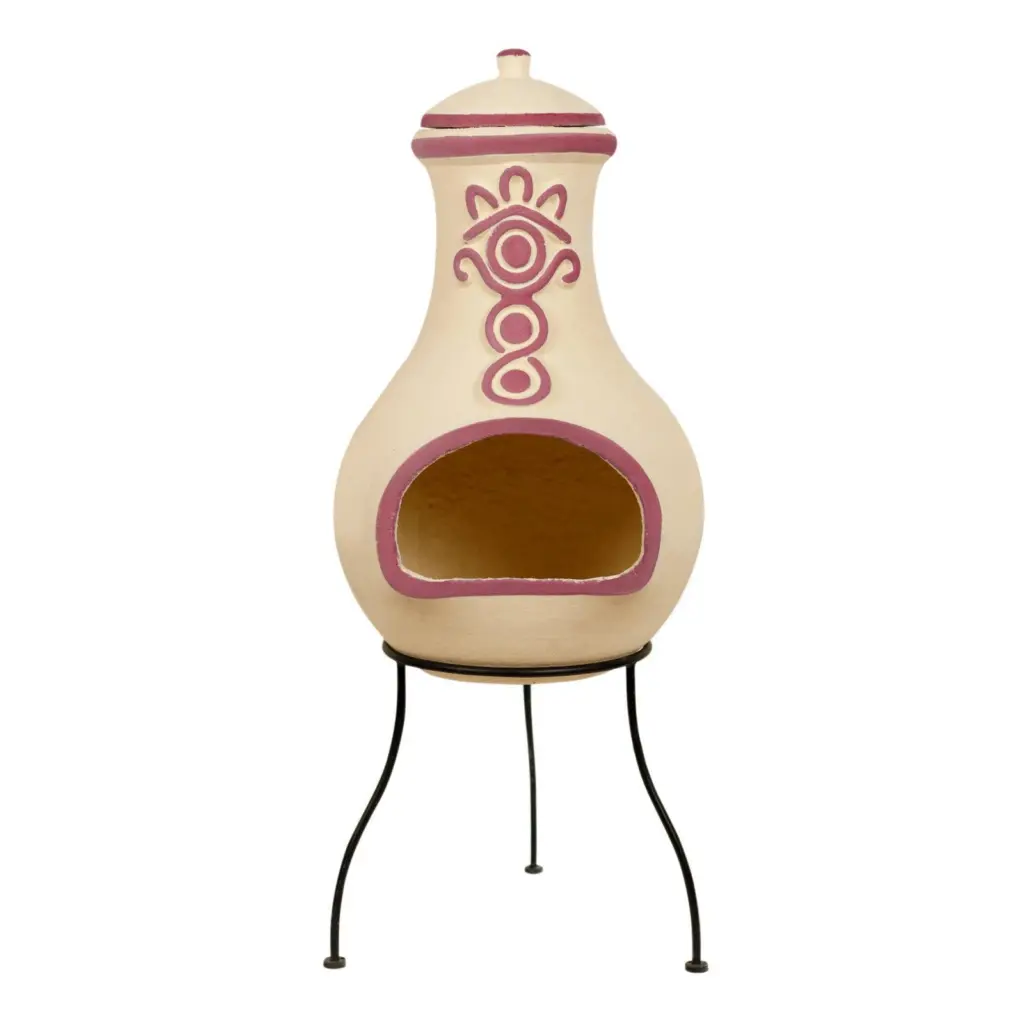
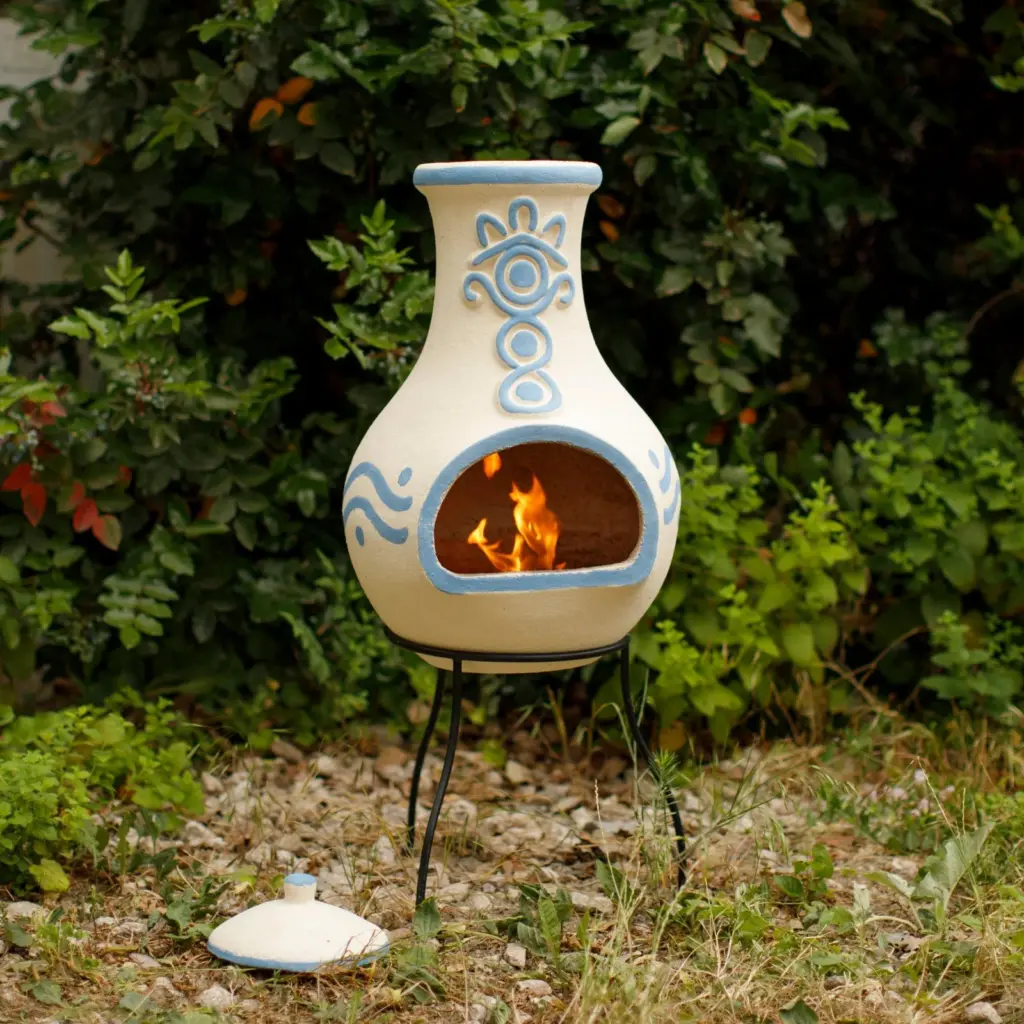
The protective lid included keeps rain out of the chimney between uses, so it’s worth putting on every time the chiminea is cold and not in use. Water that gets in through the chimney ends up in the sand and in the base of the bowl, and damp clay must not be heated quickly. If rain has got inside anyway, leave it to dry for a few days and start with a small fire.
A waterproof but breathable cover is useful in the rainy season or if the chiminea stands exposed to the weather. The rule is simple: the cover only goes on a chiminea that is completely cold and dry. Put over a wet bowl, it traps the moisture inside and does more harm than good.
How do you store a clay garden chiminea over winter?
In winter, the safest place for a clay chiminea is under cover: a garage, a shed, an outbuilding — any dry space where water has no way of freezing inside it. The danger isn’t the cold itself but the combination of moisture and frost. Water absorbed by the clay freezes, expands and, after several freeze-thaw cycles, can flake pieces off the surface or open up cracks.
- Empty out the ash and, if it is damp, the sand too; put in dry sand before the first fire in spring.
- Let the bowl dry out completely before you store it.
- If you have nowhere to move it, raise it off the ground, put the lid on and cover it, in a corner sheltered from the wind and from drifting snow.
Using it on cold autumn days isn’t forbidden, but it calls for even more patience: a small fire to start with, and never in a wet or frozen bowl.
What should you do if a crack appears?
First, work out what kind of crack it is. A natural ceramic chiminea used with an open fire may develop fine, surface-level hairline cracks over time. These are normal and do not affect safety or performance. A crack that goes right through the wall, widens from one use to the next or lets the firelight show through is a different matter: stop using it and don’t light another fire until you have cleared up the situation.
Most serious cracks have the same causes: a big fire without curing, too much wood added at once, rain or water on hot clay, frost while the bowl is wet, and knocks when it is moved. That’s why the best repair is still prevention: the right-sized flame, dryness and shelter in winter. Other questions about use, delivery and warranty are answered on our FAQ page, and if you’re still choosing, see the 87 cm clay garden chiminea, lid included.
Can I leave a clay chiminea outside all winter?
It isn’t recommended. If you have no other option, keep it dry, raised off the ground, with the lid on and under a cover, and don’t light it while it is wet or frozen.
Does it need curing again every spring?
A full cure isn’t needed, but the first fire of the season must be small, in a thoroughly dry bowl, and the flame should be built up gradually from one evening to the next.
How do you put the fire out without water?
Stop adding wood towards the end of the evening and let it burn right down to ash. In an emergency, people’s safety always comes before the ceramic.