A fire pit in the garden or backyard: how to set one up safely
A garden fire pit belongs on level, non-combustible ground, away from the house, wooden fences and branches, in a spot where the wind won’t carry the smoke towards the windows. Then you choose the form: a brick or stone ring, a shallow pit in the ground or a ready-made fireplace that you stand on slabs, such as a clay garden chiminea.
Below are the steps in the order they matter: where to put it, what to build it from, how to use it without worry and when it’s worth skipping the building work. We don’t sell brick or stone, so the advice below is what we would give anyone.
Where should you put a fire pit in your garden?
Choose the spot before the materials. Most problems with a fire in the garden come from a badly chosen spot, not from the construction.
- Away from anything that can catch fire: the walls of the house, wooden fences, the shed, the gazebo, fabric furniture, the woodpile. For an enclosed chiminea we recommend 2-3 m of clearance; an open fire needs even more free space around it.
- Nothing overhead: no low branches, eaves, pergola or cables.
- Level, stable ground, with no dry grass and no thick roots at the surface.
- The wind and the neighbours: notice which way the wind usually blows and where the windows are, yours and your neighbours’. Smoke follows the wind.
We apply the same reasoning to the clay chiminea, with all the details about terraces and decks, in the guide where to place your garden chiminea.
What to build your fire pit from: brick, stone or in the ground
The simplest form is a ring on a base that doesn’t burn. The most popular options:
- Brick fire pit. Lay the bricks in a circle on a bed of well-compacted gravel or sand. For the inner course, which sits directly in the fire, firebrick stands up to heat better than ordinary brick. Avoid hollow bricks, which can shatter in the heat.
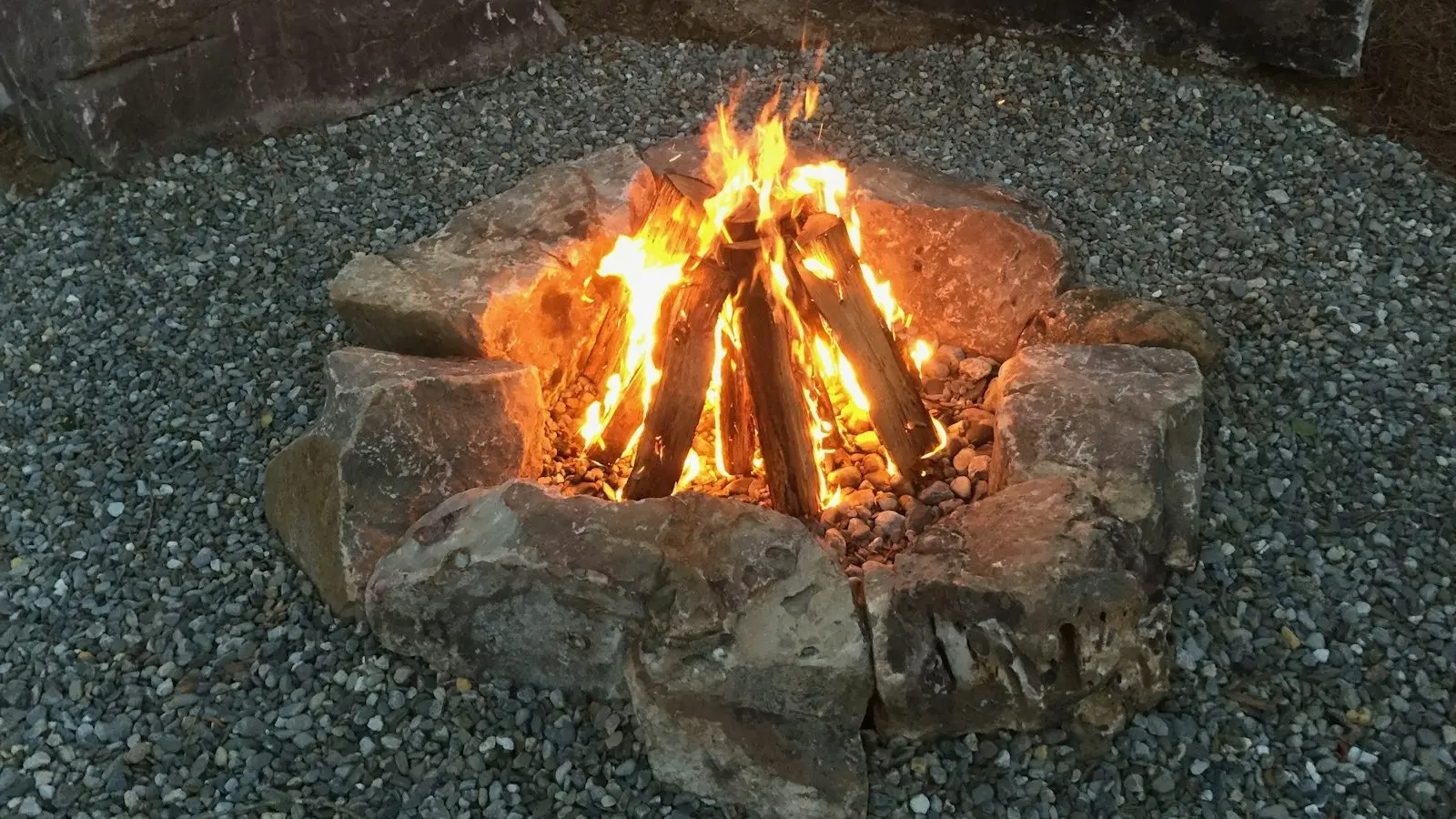
- Stone fire pit. It looks natural in the garden. Choose dry, dense stone. Avoid river stones or stones that have been sitting in water: the moisture in them can suddenly turn to steam and crack them.
- In-ground fire pit. A shallow pit, cleared of grass and roots, ringed with stone or brick so the fire can’t spread at the edges.
- Gabion or old wheel rim. These are improvised solutions. If you use a steel wheel rim, remove the tyre and don’t burn paint or rubber: their smoke is toxic.
Whichever you choose, leave a border of gravel or slabs around the ring, so that sparks and stray embers land on something that won’t burn.
A fire pit for a cauldron and a grill
If you want to cook in a cauldron or on a grill, an open fire pit is the right option: you’ll need a tripod or a sturdy stand for the cauldron, or a grate set on the rim of the ring. Put the stand on level ground and keep children away from the hot pot. A clay chiminea isn’t made for a cauldron. With it, you only cook simply, over the embers: skewers, vegetables or potatoes in foil.
Are you allowed to light a fire in your garden?
The rules vary from one locality to another, and temporary bans can apply during dry spells. Ask your town hall what applies where you live before you build. A few things hold everywhere:
- A fire pit is for clean, dry wood. Don’t burn rubbish, plastic, painted or treated wood, wet leaves or garden waste: the smoke is toxic or heavy, and burning waste is banned in many places.
- Don’t light a fire in strong wind, and never leave it unattended, not even for a moment.
- Think of the neighbours: a small fire with dry wood makes far less smoke than a big one with green wood. Which wood makes good firewood is covered in the guide what to burn in a garden chiminea.
How do you use a fire pit safely?
- Keep a bucket of water or sand within reach and, ideally, a fire extinguisher.
- Light the fire with paper and kindling, not with petrol or other liquids.
- Add a few logs at a time, not a heap.
- At the end, let the wood burn down to ash. In a stone or brick fire pit, put out the remaining embers with water and stir them until they are cold. In a clay chiminea, never pour water on the hot ceramic: let it go out and cool down on its own.
The no-build option: a ready-made fireplace
If you don’t want to dig, haul stone and lay bricks, you can stand a ready-made fireplace on slabs. A clay garden chiminea is an enclosed, wood-burning fireplace: it needs no construction, only a non-combustible base such as concrete slabs, stone or brick. The fire burns inside, the wide bowl keeps the sparks in and the chimney draws the smoke upwards. That makes it suitable even where an open fire would be too close to the house.
Our chimineas are handmade from 100% natural clay, stand 87 cm tall together with the three-legged stand, weigh between 17.2 and 19.9 kg and come with a protective lid. They burn wood (and charcoal, in moderation) and are easy to move from one spot to another once completely cold. Before the first fire, they need curing: a small paper fire in the empty bowl, then sand in the bottom and a few more small fires; the steps are in the guide the first firing of a clay chiminea. If you’re not yet sure what suits you, read the comparison open fire pit or clay chiminea, and for cool evenings on the terrace, the guide how to heat your terrace.
See our clay garden chimineas or go straight to the model with red ornaments. The current price is on the product page. And if your spot calls for a big campfire with a cauldron, build the ring: it’s just as good a choice.
Can I make a fire pit directly in the ground?
Yes, in a shallow pit cleared of grass and roots, ringed with stone or brick. Not on dry grass and not near tree roots.
What brick should I use for a fire pit?
For the inner course, which sits directly in the fire, firebrick withstands heat better. Avoid hollow bricks and river stones, which can crack.
How far from the house should a fire pit be?
As far as possible from walls, wooden fences, fabric furniture and branches. For an enclosed chiminea we recommend 2-3 m; an open fire needs even more free space.
Can I stand a clay chiminea on an existing fire pit?
Yes, if the base is level, stable and non-combustible, such as slabs, brick or stone, and you don’t put the stand over embers or hot ash.